More and more people open ChatGPT to plan Walt Disney World before they open anything else. It makes sense: you're facing fourteen empty days and no idea which one should be Magic Kingdom, and a chatbot will happily hand you a full itinerary in thirty seconds. As a starting point, that's genuinely useful. As a finished plan, it will quietly let you down — usually on the exact details that cost money or ruin a morning.
This guide does two things. First, it shows you the shape of a prompt that gets a good draft out of ChatGPT (or Claude, or Gemini — the technique is the same) instead of a generic one. Then it's honest about where those drafts fall down, and what to do with the result so it becomes a plan you can actually book.
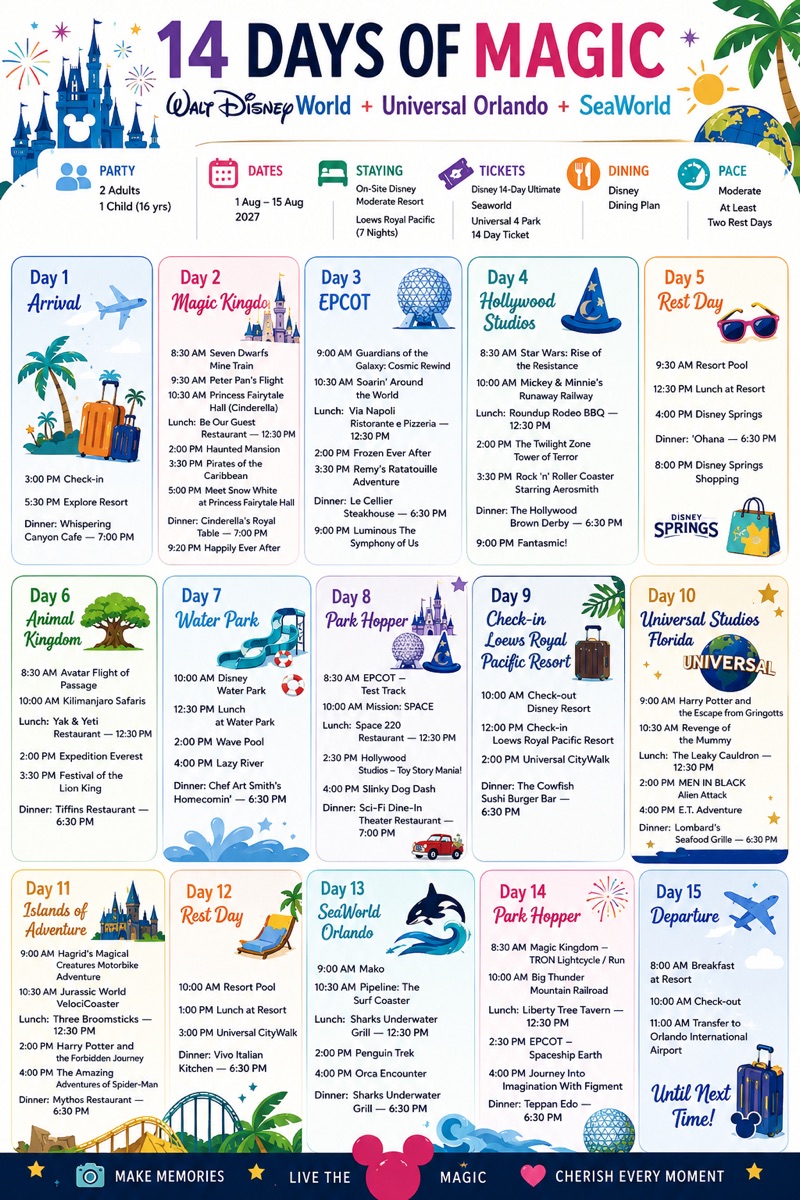
Why start with AI at all
The blank page is the hardest part of planning Disney, and AI is very good at un-blanking it. Ask well and you'll get a sensible skeleton: a rough park order, a first pass at pacing, a rest day in roughly the right place, some restaurant ideas to react to. Reacting to a draft is far easier than conjuring one — "no, swap those two days" is a five-second decision; "design my whole fortnight" is not.
So the goal isn't to get a perfect itinerary out of ChatGPT. It's to get a good enough draft that you have something to argue with.
The shape of a good prompt
Most disappointing AI itineraries come from a lazy prompt — "plan me a two-week Disney trip." The model has nothing to work with, so it gives you the average of every trip on the internet: front-loaded, over-packed, and nothing like your family. A good prompt does the model's hardest job for it: it supplies the constraints.
Give it five things: who's going, when, how fast you want to move, what you can't miss, and what to avoid. Then ask for structure you can actually use. Here's a template — paste it in and fill the brackets:
You're helping me plan a Walt Disney World trip. Here are the facts:
- Who: [2 adults, 2 kids aged 6 and 9]
- When: [14 nights, arriving 11 August 2027]
- Pace: [relaxed — a lie-in most days, no more than one park per day, and a proper rest or pool day every third or fourth day]
- Must-dos: [one character breakfast, at least one water park, Magic Kingdom fireworks]
- Avoid: [no rope drop the day after the water park; nothing too intense for the 6-year-old]
Please give me a day-by-day plan as a table: date, park or activity, and a one-line reason. Put the busiest days early while we're fresh, keep the second week calmer, and leave the last full day light. Flag anything you're assuming or unsure about rather than stating it as fact, and don't invent specific restaurant availability or ride opening dates.
Two lines in there do a lot of heavy lifting. Asking for a table with a reason per day forces the model to justify its choices, which makes bad ones easier to spot. And asking it to flag its assumptions is the single most useful instruction you can give an AI planner — it turns confident nonsense into a labelled guess you can check.
Then keep talking to it. "Move Animal Kingdom to day nine." "Give us a pool afternoon on day four." "We're not early risers — rework the mornings." The draft gets better every time you push back, because you're feeding it the constraints it couldn't have known.
Where AI itineraries fall down
Here's the part the chatbot won't tell you. A language model is a superb writer and a poor source of live, specific facts — and Disney planning is almost entirely live, specific facts.
- It doesn't know today's Disney. Park hours, Early Entry times, ride refurbishments, seasonal closures, brand-new attractions, and the current 2027 UK offers all change constantly. The model's knowledge has a cut-off date and doesn't update, so it will confidently describe a park schedule that no longer exists.
- It invents things that sound right. Ask for restaurants and you may get one that closed years ago, or a plausible-sounding grill that never existed. The same happens with ride names and "tips." It's not lying — it's pattern-matching — but the result is the same: details you can't trust without checking every one.
- It has no idea what you can actually book. Disney dining opens 60 days out and the hard tables go fast. ChatGPT will cheerfully "book" you a 7pm character breakfast it has no way of knowing is available — because it can't see the reservation system at all.
- It can't do the one thing that matters on the day. No AI chat can hold a live restaurant reservation or a Lightning Lane. It writes the plan; every actual booking is still yours to make, at the right time, in My Disney Experience.
- It over-packs and under-thinks geography. Left alone, models cram three "must-dos" into a day that's physically a fourteen-hour march, ignore travel time between resort and park, and forget that a 6am rope drop and a 10pm fireworks finish is a lot for a nine-year-old two days running.
- The confident tone hides the errors. Everything arrives in the same self-assured voice, whether it's rock-solid or completely made up. There's no highlighting on the bits that are wrong — which is exactly why the "flag your assumptions" instruction earns its place in your prompt.
None of this makes AI useless. It makes it a drafting tool, not a planning system. The draft still needs a human — and a plan that knows the real catalogue — to become bookable.
Turn the draft into a real, bookable plan
This is where the loop closes, and it's why we built the free side of Florida Planned. When you've got a ChatGPT itinerary you're reasonably happy with, you don't have to retype it into a planner by hand. Bring it straight to us.
Florida Planned's import is free for everyone — no card, no sign-up wall. Paste the text straight out of ChatGPT (or upload the document) and Flo, our planning companion, reads it and maps it onto your trip canvas: the days and dates, which park each day belongs to, rest and travel days, the restaurants matched against the real catalogue, the named rides. Anything ambiguous or invented, she flags for you to place rather than guessing — so the made-up grill quietly surfaces instead of surviving to booking morning.
What you get back is the thing ChatGPT can't give you: a live, editable plan instead of a wall of text. From there it's a real planner — drag a day, retime a meal, build a ranked dining wishlist, and walk into the 60-day booking window with a priority list instead of a panic. Unlock the trip (one £14 launch payment, which opens every premium feature) and Flo will plan the whole thing with you in conversation from that point on — but the import, the part that rescues your ChatGPT draft, costs nothing.
The short version: let AI break the blank page, then bring the draft somewhere that knows the real Disney. That hand-off is the whole trick.
FAQ
Can ChatGPT plan a Walt Disney World trip? It can write a useful first draft — a park order, rough pacing, restaurant ideas — especially if you give it a detailed prompt with your family, dates, pace and must-dos. It can't check live park hours, confirm dining availability, or book anything, so treat the output as a starting point to refine, not a finished plan.
What's the best prompt for a Disney itinerary? Give the model five things — who's going, when, how fast you want to move, what you can't miss, and what to avoid — then ask for a day-by-day table with a reason for each day and tell it to flag any assumptions rather than state them as fact. That structure gets a far more usable draft than "plan me a Disney trip."
Why are AI Disney itineraries sometimes wrong? Language models work from training data with a cut-off date, not from Disney's live systems. So they can describe out-of-date park hours, suggest restaurants that have closed, invent attractions, and "book" tables they can't actually see — all in the same confident tone. Every specific detail needs checking.
How do I turn my ChatGPT itinerary into a real plan? Bring it to Florida Planned. Our import is free for everyone: paste the text or upload the document and Flo maps it onto an editable trip canvas, matches the restaurants and rides against the real catalogue, and flags anything she can't place. You end up with a live plan you can adjust and book from, instead of a block of text.
Does Florida Planned book my restaurants for me? No — Disney requires you to book through My Disney Experience yourself. Florida Planned builds and sequences the plan and tells you what to book and when; the booking-morning clicks stay yours.
Already got a ChatGPT itinerary? Bring it to the Florida Planned trip planner — Flo reads it and maps it onto an editable canvas, free, no card needed. Or meet Flo first and see how the free import works.